Why strong hips are important for running and the best way to strengthen them
Strong hip muscles are essential for efficient running and injury prevention, says strength and conditioning expert Dave Cripps. Here he explains more...

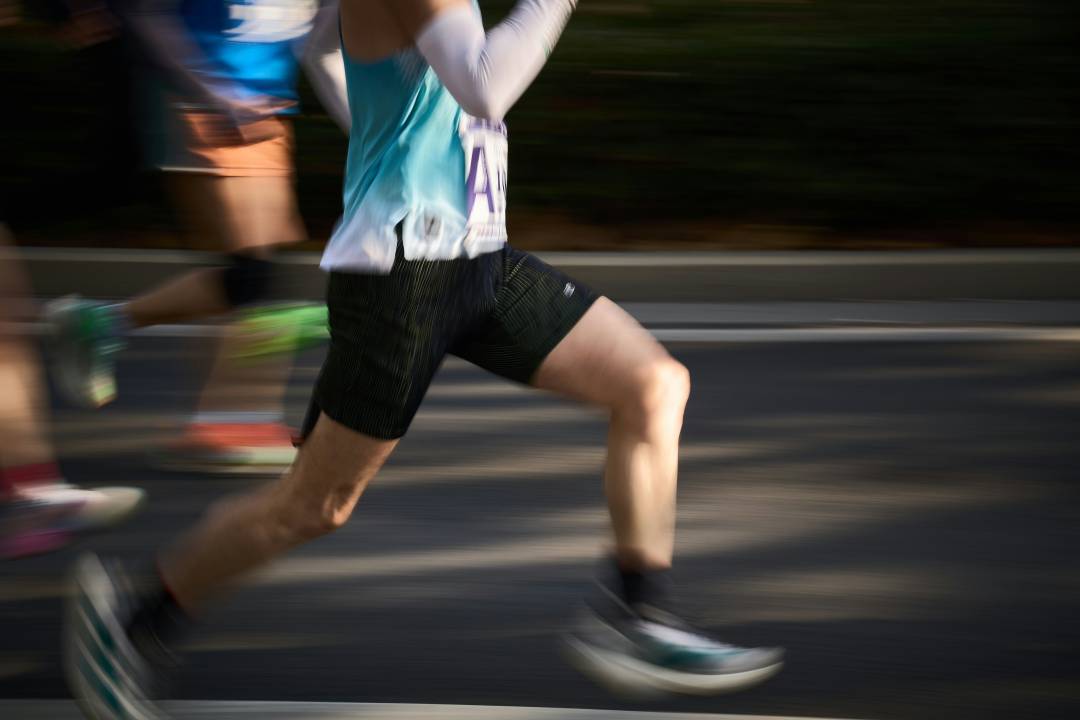
Running heavily loads the hip muscles, often more than the legs, making them prone to early fatigue. Despite growing awareness of how crucial hip and glute strength is for efficient running, many athletes continue to ignore this key performance area.
Research states that poor hip strength is related to increased risk of injury and poor running mechanics and performance.
The main muscle groups in the hip are your gluteals, hamstrings, adductors, psoas muscles and the anterior core (consisting of multiple abdominal muscles), while there are three main ligaments.
Your hip muscles play a major role in maintaining an efficient body position when you run. In particular, as you run your gluteal and hamstring muscles help to extend your hip, alongside controlling rotation and inward movement.
Essentially, this reduces many of the undesirable running techniques characteristic of poorer run performance. But why can improving this aspect help you as a triathlete?
Why strong hips can help prevent injuries

We all want to minimise our time out injured – and you can do so by focusing on the hips because there’s comprehensive evidence that shows weaknesses in certain hip muscles are linked to common injuries.
For example, runners who had iliotibial band (ITB) syndrome were shown to have poorer strength in the muscles that prevent the knee and hip ‘rolling and turning in’ during running (Freidricson et al. 2000).
Also, those with weaker muscles that extend the hip were reported to be at greater risk of kneecap pain (Souza and Powers, 2009).
Consequently, you as a triathlete can minimise your risk of sustaining common injuries, by improving the strength of muscles that extend the hip and prevent inward motion.
Interestingly, it’s even been suggested that females have a greater demand placed on their gluteal muscles, which creates an even greater risk of poor running mechanics compared to males (e.g. inward motion of the hip and knee) (Wilson et al. 2012).
So the benefits of this training aren’t only limited to certain triathlon populations or abilities, everyone can benefit.
How strong hips can improve your run performance
Numerous studies highlight the link between the strength of your hips and your running performance, in particular when it comes to maintaining a more superior stride length when running (Hayes et al. 2004).
By increasing your hip strength, you’re also more likely to avoid undesirable run mechanics that are associated with less efficient running, including hip drop, overstriding, and excess toe or heel striking.
There are not just benefits to running. Performing lower-body strength training each week, which includes exercises to train hip muscles, is also linked to higher power outputs and better time-trial performance over various distances (Mujika et al. 2015).
How can you strengthen your hips?

Resistance training is the best method of building hip strength, particularly exercises which focus on extending, rotating and pushing out your hip.
However, a current problem in triathlon strength and conditioning is the lack of information and understanding of how to do this practically.
For example, seeing the above movements in isolation often creates strength programmes with excessive numbers of exercises and, therefore, repetitions.
This is critical as excessive volume increases the likelihood of significant delayed muscle soreness, in addition to unnecessarily lengthy training sessions.
The breakthrough comes from understanding that the movements and muscles listed above can be trained at once. For example, exercises like the following train multiple of the key muscle areas for triathletes at once:
- Split squat – stand in a staggered stance, drop your back knee toward the floor, then drive through the front heel to stand.
- Single leg squat – balance on one leg, sit back and down into a controlled squat, then stand back up without letting the knee collapse inward. You can use a chair under you to aid the movement.
- Reverse lunge – step one foot straight back into a lunge, lower your stance until both knees are bent to 90 degrees but not more, then push through the front leg and heel to return.
That said, we do commonly find in triathletes that certain muscles or movements can be such a weak link in the overall movement of running that they do need specific isolation. This is where strength exercises to isolate the gluteal muscles can work well. For instance, these exercise isolate the glutes:
- Crab walks – with a resistance band around your knees or ankles, stay low in a squat and step sideways while keeping constant tension and staying at the same level. You can also do this without band as after a while, the burn will come regardless!
- Cook hip lifts – lying on your back, hug one knee to your chest and push up into a bridge through the opposite leg, pushing through the heel.
Equally, also for the hamstring, examples that isolate the muscle are:
- Single-leg hamstring slide outs – from a bridge position, extend one leg and slowly slide the heel away, then pull it back in.
- Single-leg Romanian deadlifts – from a standing position, hinge at the hips on one leg, letting the other leg extend behind you, then return tp upright position. Be sure to maintain a flat back througho.
Evidence clearly shows the value of engaging in strength training to improve running and other elements of performance. The need to be able to do this in a focused manner, using exercises which address many aspects, is a key factor when, as triathletes, training time is limited, and there’s often fatigue build-up.
Like with any health issue, if you have any concerns at all, seek medical advice from a qualified medical practitioner, whether that’s a doctor or physiotherapist.
Who is Dave Cripps?
Author Dave Cripps is the director of Coalition Performance, a leading strength and conditioning rehab centre.
He holds both BSc and MSc degrees in sport and exercise science, and is a fully accredited strength and conditioning coach by the UK Strength and Conditioning Association.
He’s worked professionally as a strength and conditioning coach for over a decade, in over 20 sports at both world-class and amateur levels, including triathlon, cycling, running, and swimming.


 David Cripps
Strength and conditioning coach
David Cripps
Strength and conditioning coach